
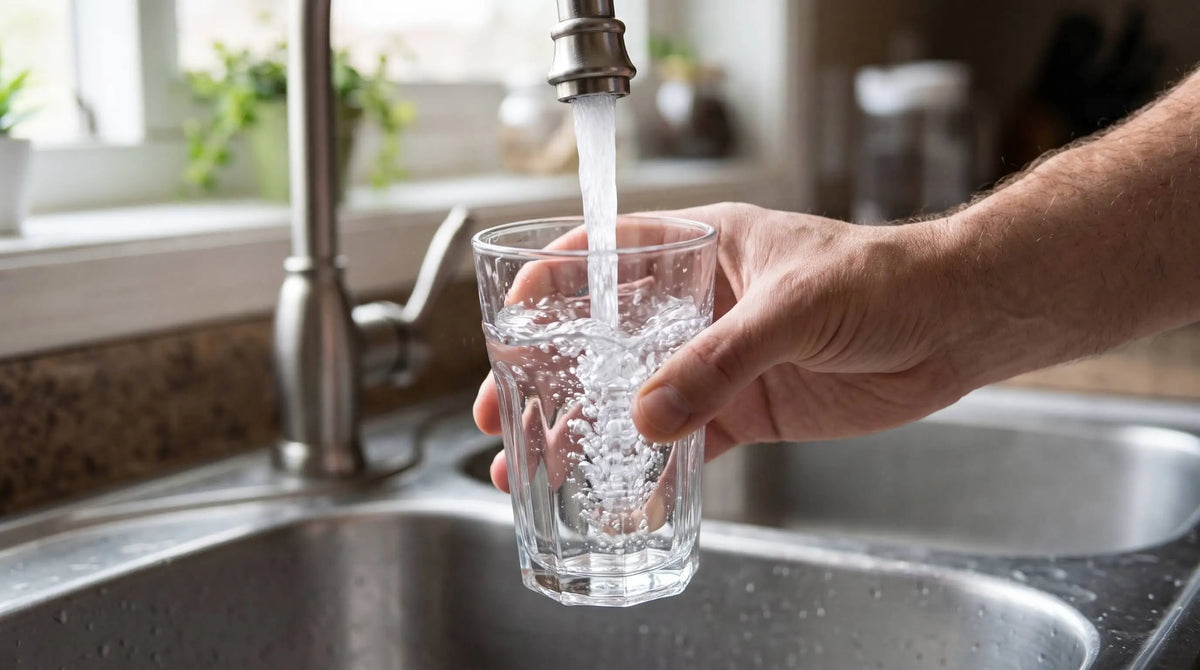
Does your tap water taste or smell like a swimming pool? This is often due to the chlorine used to disinfect water before it is distributed. At regulated concentrations, its presence does not necessarily mean there is a problem with the water's drinkability. If the taste bothers you, there are several ways to reduce it, in particular with suitable filtration.
A glass of water can be perfectly clear and still smell of chlorine. This is relatively common in supply networks where chlorine disinfection is used.
But why does this smell sometimes appear overnight? Can you get rid of it by letting the water stand? And can an activated carbon filter really improve its taste?
Why does tap water contain chlorine?
Water drawn from a river, a lake or groundwater may contain microorganisms. Depending on the origin and quality of the source, it has to undergo various treatments before being distributed.
Chlorine is one of the disinfectants used to inactivate pathogens and limit their growth in the network. A small amount of disinfectant may be maintained while the water travels through the pipes: this is known as residual disinfectant.
This protection is particularly useful when water travels long distances between the treatment plant and people's homes.
The Centers for Disease Control and Prevention (CDC) explains that chlorine and chloramines play an important role in preventing waterborne diseases.
Not all networks necessarily use the same disinfection. Some have sufficiently protected water sources to operate with different treatments.
Is it dangerous to drink water that smells of chlorine?
A slight smell of chlorine does not automatically mean that the water is dangerous. In a monitored network, it may simply be linked to the disinfection treatment.
However, a concentration that meets health requirements must be distinguished from an abnormal one. Applicable limits and disinfection practices depend on local regulations.
The intensity of the smell alone cannot measure how much chlorine is present. Two people may also perceive the same water differently.
If the taste or smell suddenly becomes very strong, unusual or persistent, contact your water supplier before assuming it is a normal variation.
Why does water smell more of chlorine on some days?
You may have noticed that the taste of your water changes from one week to the next, even though you always use the same tap.
Several factors can explain these differences:
The origin of the water supplied
A network may draw water from several sources or plants. The composition of the water and the treatment required can therefore vary from one period to another.
Network conditions
The time water spends in the pipes, maintenance work and certain treatment adjustments can change the amount of residual disinfectant at the tap.
Temperature
Temperature affects the volatilisation of certain compounds and how odours are perceived. Warmer water can therefore smell different.
The type of disinfectant
Free chlorine and chloramines do not have the same chemical characteristics. Some suppliers may change their disinfection strategy for operational reasons.
These mechanisms are documented by the CDC in its section on chlorination and chloramines.
How do you remove the chlorine taste from tap water?
If your supplier confirms that the water is safe to drink and your only problem is the taste, there are several options to consider.
1. Chill the water
Serving water cold can make certain odours less noticeable. A clean, closed jug in the fridge also makes it easy to have water at a pleasant temperature.
This method mainly changes how pleasant the water is to drink: it is neither filtration nor a guarantee that contaminants will be reduced.
2. Let the water stand
Some of the free chlorine can dissipate when water is left exposed to the air. However, the result varies with the quantity of water, the exposed surface area, the temperature and how long it stands.
This method is much less suitable for chloramines, which are more persistent. The CDC explicitly distinguishes between these two disinfectants on this point.
Avoid leaving drinking water uncovered unnecessarily for long periods: stored water must also be protected from outside contamination.
3. Use a suitable activated carbon filter
Activated carbon is used in many home filtration systems to reduce certain molecules responsible for tastes and odours.
Its porous structure provides a large surface area for interaction with the water. Certain substances can be retained by adsorption or transformed on contact with the medium.
Systems tested for chlorine reduction can therefore improve the taste characteristics of water, under the conditions specified by their manufacturer.
The NSF/ANSI 42 standard covers, among other things, aesthetic performance such as the reduction of chlorine and associated tastes or odours.
Please note: a cartridge containing activated carbon is not automatically certified. You need to check the performance of the specific model.
A verifiable example: the Berkey Phoenix elements, sold on Nice Water, are listed in the NSF directory for the NSF/ANSI 42 standard, which covers, among other things, the reduction of chlorine, taste and odour.
A filter that is effective against free chlorine is not necessarily as effective against chloramines. Their reduction depends in particular on the filter medium, the contact time and the tests carried out. So if your supplier uses chloramines, look for a specific claim.
Which filtration system should you choose to improve the taste of your water?
You do not need to choose the most complex system to solve a simple taste problem. The right solution depends mainly on the quality of your water and your habits.
A filter jug may be suitable for occasional use if its performance matches your needs. A system installed on the worktop or under the sink may be more practical if you use large amounts of water every day.
Gravity filtration is another approach, with no direct connection to the plumbing, and with its own constraints in terms of flow rate, refilling and maintenance.
A solution available from NiceWater: Coldstream MAX
NiceWater offers, among others, the Coldstream MAX CF1082W filter, designed for certain compatible under-sink filtration systems.
It combines a ceramic structure with an activated carbon core. The NiceWater product page lists, among other things, chlorine reduction, along with other contaminants.
This performance must be assessed against the documentation and tests specific to this cartridge: it does not automatically extend to all ceramic or activated carbon filters.
Coldstream MAX CF1082W filter
A cartridge for compatible under-sink systems, combining ceramic filtration and activated carbon. Among other things, it is presented for chlorine reduction.
Check compatibility with your installation and the performance data before ordering.
Discover the Coldstream MAXCan a filter remove chlorine without removing minerals?
Yes, depending on the technology used. Reducing chlorine and reducing dissolved minerals are two different mechanisms.
Activated carbon filtration designed to improve taste does not necessarily reduce calcium and magnesium concentrations significantly.
This is an important distinction: water that tastes less of chlorine does not automatically become less hard.
To choose correctly, it is better to start from an identified problem than to look for a device that promises to remove everything.
When should a change in taste concern you?
A slight, stable chlorine taste may be linked to the normal operation of the network. However, certain changes are worth checking.
If your water suddenly smells much stronger: check your supplier's announcements and ask whether any work or change in treatment has taken place.
If the water turns brown or cloudy, or has an unusual smell: do not assume that a home filter will solve the problem. Report the issue and ask for the appropriate instructions.
If several households are affected: it may be useful to pass this information on to the supplier so that it can check the network.
If there is an official do-not-drink or boil-water notice: follow the authorities' instructions. A cartridge designed to improve taste does not replace these safety measures.
Frequently asked questions
Does boiling water remove chlorine?
Heating helps some of the free chlorine to dissipate, but boiling drinking water just to improve its taste is generally not the most practical solution. It uses energy and does not reliably deal with all disinfectants or contaminants.
Why does hot water sometimes smell stronger?
Temperature can encourage the release of certain odorous compounds and change how they are perceived. For drinking or cooking, use cold tap water by preference, then heat it if necessary.
Does an activated carbon filter remove bacteria?
Activated carbon alone should not be considered a guarantee of disinfection. Microbiological reductions must be specifically demonstrated for the system used.
Can you measure chlorine at home?
Suitable tests can measure free chlorine or total chlorine. It is important to distinguish between these parameters and to follow the test manufacturer's instructions. If a health problem is suspected, official analyses remain the reference.
Slightly chlorinated tap water can fully comply with health requirements. The taste sometimes comes from the residual disinfectant that protects the water as it travels through the pipes.
If the water quality is confirmed and only the taste bothers you, chilling or suitable activated carbon filtration can make it more pleasant to drink. However, a significant and unusual change should first be reported to the supplier.